
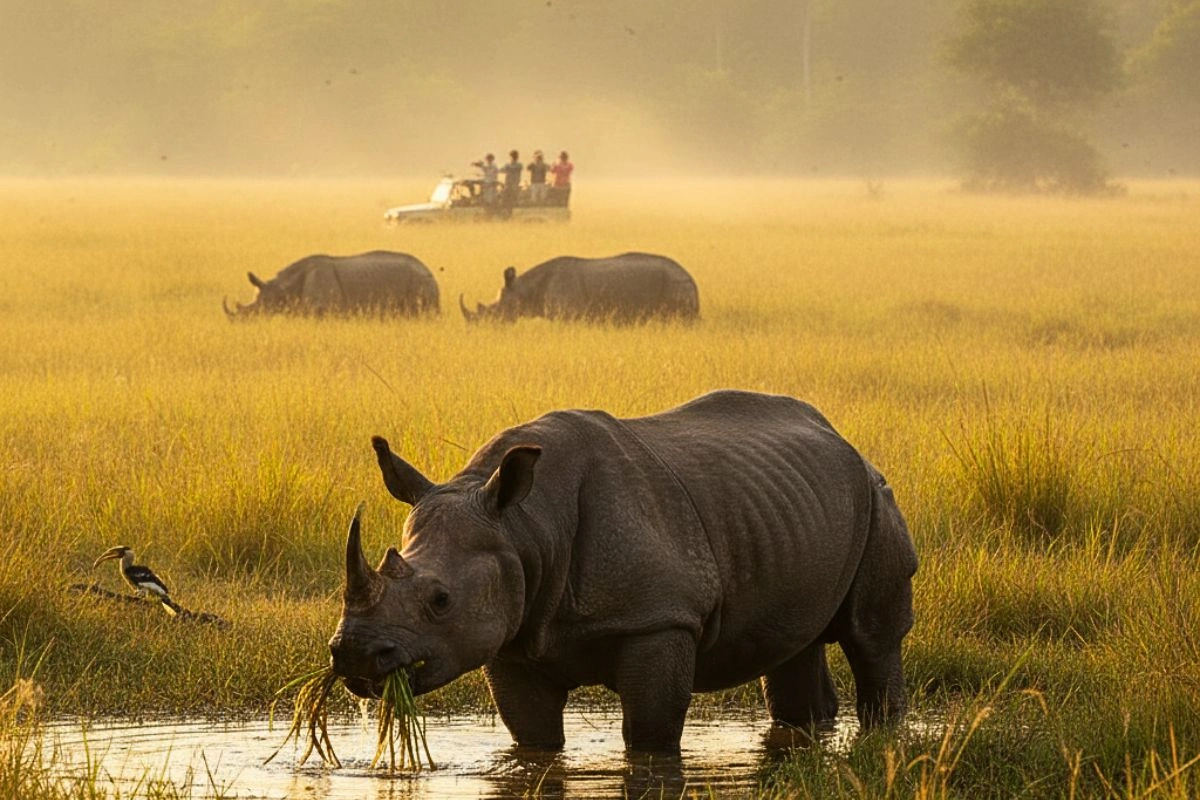
Founded in 1908, Kaziranga National Park is a national park in the Golaghat and Nagaon districts of Assam, India. One of India’s most popular wildlife vacation destinations, the 430-square-kilometer area of Kaziranga National Park is eyespot with elephant grass meadows, marshy lagoons, and dense forests. It is home to more than 2,200 Indian rhinos, about two-thirds of the world’s total population.
Undoubtedly known for its abundance of animals, but the wildlife conservation activities that take place within the park are also popular. The park has succeeded in increasing the population of the endangered giant horned rhinoceros through its amazing wildlife conservation efforts. The vast expanses of tall elephant grass, marshes, and dense tropical moist deciduous forests undoubtedly make the park beautiful, but what makes it more catchy is the Brahmaputra River.
The most convenient way to reach Kohora is to fly to Guwahati if you are arriving from outside North East India. Guwahati has regular flights to Delhi, Kolkata, Imphal, Agartalla, Bagdogra, Dibrugarh, Silchar and Jorhat. Once you reach Guwahati and you can continue on the road to Kohora/Bagori. By car, it takes about 4-5 hours.
Rail takes you to Guwahati, which is well-connected to the rest of India. From Guwahati, you can drive to Kohora by car. There is also a train from Guwahati/Dibrugarh to Jorhat. You can get off at Jorhat and follow the road to Kohora.
Kohora is the main tourist center of Kaziranga. It is located along National Highway 37 (NH 37), which connects Guwahati to the west and Jorhat to the east. It is directly accessible from Guwahati by road (NH 37). Travel time is 4-5 hours, depending on travel time and traffic jam.
Due to the difference in elevation between the east and west sides of the park, four main types of vegetation can be seen here. Consists of alluvial flooded grasslands, alluvial savannah forests, tropical moist mixed deciduous forests, and tropical semi-evergreen forests. Famous trees that can be seen in the park include Kumbi, Indian Gooseberry, Cotton Tree, and Elephant He Apple. Lakes, ponds, and riverbanks are also home to a wide variety of aquatic plants.
The woodlands of Kaziranga Park are home to the largest Indian rhinoceros habitat in the world. Other animals found in Kaziranga’s elephant grass, marshes, and dense tropical wet deciduous forests include Hoolock Gibbons, Tigers, Leopards, Indian elephants, sloth bears, wild buffaloes, and swamp deer. The tiger population is increasing year by year. In 2006, Kaziranga government officials declared it a tiger sanctuary. Again, numerous migratory bird species from Central Asia can be found here.
There are many other tourist attractions in Park. The abundance of attractions and activities in this park makes it a great place for a vacation with family and friends. Here are some of the things you can explore in Kaziranga National Park.
The park offers two types of Safaris:
If wildlife viewing is your top priority, a jeep safari is the most affordable way to explore Kaziranga’s flora and fauna. For those on a tighter budget, a 4×4 gypsy safari is an even better option. The jeep is perfect for wildlife watching and allows you to experience nature up close. If you are a true nature lover and want to use a jeep for your safari, booking in advance is the only way. Plan your safari two to three months in advance to determine your preferred zone within the national park.
Elephant safari is the best and safest way to explore the most remote and pristine areas of the Kaziranga Forest. If you like exploring dense woodlands and looking for unfamiliar creatures, elephant riding is the way to go. This helps visitors navigate difficult terrain that jeeps can’t reach. However, Elephant Safari zones are split into two zones- Central Range or Kohora Range and Western Range or Bagori. Seats are available on a first-come, first-served basis.
Eagle Safaris is an independent wildlife travel and safari facilitation platform offering information, travel assistance, safari planning, accommodation coordination, and tourism-related services across various destinations in India.
We hereby clarify that Eagle Safaris does not claim ownership, partnership, affiliation, sponsorship, or official association with any resort, hotel, lodge, forest department, national park, tiger reserve, wildlife sanctuary, or government authority unless explicitly stated. Further, Amigo Performance Marketing OPC Pvt Ltd is duly authorized to market, promote, manage, and operate digital advertising, branding, and promotional campaigns for Eagle Safaris across digital and other media platforms.
If any trademark owner, property owner, or authorized representative has concerns regarding content, branding references, or listings appearing on this website, they may contact us directly for immediate review and resolution.